“Tara is the mother of all the Buddhas. When you practice Tara you come closer to her, and can feel her motherly love; you feel you are well-loved and nurtured by the most beautiful mother of all Buddhas.” — Tara in the palm of your hand, Venerable Zasep Rinpoche.
“Tara is without doubt the most beloved female deity in Tibetan Buddhism, revered for her swiftness in helping those who rely on her. She has been described as a Buddha for our modern age, a sublime personification of compassion and wisdom in female form at a time when sorrow and suffering seem to be increasing everywhere. Of all the Buddhas, Tara is the most accessible.” — From the book Tara in the palm of your hand, by Venerable Zasep Tulku Rinpoche [1]
Tara is the Buddha of Enlightened Activity. Tara (Drolma in Tibetan) is often just called the “saviouress”, not just in the sense of spiritual salvation, but also as a rescuer of beings suffering in samsara here and now. Just as a child might call out for her mother if she is in danger, devout Tibetan Buddhists tend to call out for Tara in times of need.
Green Tara on a lotus is visualized with one leg outstretched — ready to leap to the aid of people in trouble. Above her head is her own guru Amitabha Buddha.
We can relax in her presence and look at ourselves honestly, knowing that Tara will not judge, reject or abandon us due to our shortcomings. Like a mother, she sees her child’s potential — in this case our spiritual potential or Buddha-nature — and wants to nurture it.
She is also popular because she is all about speed — a big deal to modern people. Thubten Chodron writes, “Aspirations made in the presences of Green Tara may easily grow into results, and requests made to her may be quickly actualized. One reason for this is that by visualizing and praying to Tara, we are energized to create causes for happiness and to eliminate interference in our Dharma practice.”
Like all Buddha’s, She is a fully enlightened being with an omniscient mind. All Buddhas have the same qualities. Buddhas have no defilements. Tara has no defilement. She has no afflictive obscurations, the ones that keep us in samsara: ignorance, anger, and all other karmic afflictions that keep us in cyclic existence. Tara is no different from other enlightened beings, such as Amitabha (Amita), Avaolokitesvara (Chenrezig or Guanine), Vajrapani or Manjushri.
Although the attainments and qualities of equanimity, love, compassion, joy and the six far-reaching attitudes are the same, Tara is considered to be the “activity of compassion”. All Enlightened Buddhas have the same essence. Yet we associate Green Tara with a motherly protective activity of compassion. To take other examples, Avalokitesvara is associated with “compassion”, Manjusri with “wisdom” and Vajrapani with “power” — yet all are equally fully Enlightened Beings with the same realizations. All the Buddhas contain these qualities, but Tara attracts those who benefit most from compassionate action.
“Tara is not a concrete, self-existent person with a personality, and for this reason, we train our minds to see her as an emanation of the good qualities that we want to cultivate,” explains Bikshuni Thubten Chodron in her popular book How to Free Your Mind: Tara the Liberator.
She goes on to explain, “A Buddha has two main bodies: a dharmakaya or truth body, and a rupakaya or form body.” The omniscient mind that has eliminated defilements is the dharmakaya, she explains. The rupakaya, are various forms assumed by enlightened beings to communicate more effectively with us.
“Anyone can pray to Tara, even people who are not Buddhists. However, if you take refuge in Buddha, Dharma and Sangha, take Tara initiation, and regularly practice a Tara Sadhana, your prayers will be more beneficial.”
Why would Tara help a non Buddhist? Putting aside the obvious answer — compassion and love — She is part of all of us. In Buddhist philosophy, all people, all sentient beings — even insects — have “Buddha Nature”, or the potential to become Enlightened. We call on our own inherent Buddha Nature, when we outwardly call on any Buddha or Enlightened Being.
Even someone who has not take Refuge has Buddha Nature. Simply recognizing that nature — which naturally happens if you call out Tara’s name in times of trouble — can be enough to activate that nature. Whether that rescue becomes a subconscious one, where our own mind triggers instinct and motherly intuition that “saves us” from trouble, or an overt one, such as Zasep Rinpoche’s story of the balcony falling on the cars.
Mama Tara
“Tara is the mother of all the Buddhas. When you practice Tara you come closer to her, and can feel her motherly love; you feel you are well-loved and nurtured by the most beautiful mother of all Buddhas.” — Tara in the palm of your hand, Venerable Zasep Rinpoche.
Why is Tara often called Mummy Tara? This is not just an endearment, to millions of followers who find refuge in Her active mothering aspects.
“Her female form represents wisdom, the essential element needed to remove the ignorance that misconstrues reality and is the root of our suffering.” — Bhikshuni Chodron [2]
Thubten Chodron continues: “Thus she is called “the mother of all the Buddhas,” for the wisdom realizing reality that she embodies give birth to full enlightenment, the state of freedom from self-grasping ignorance and its attendant self-centredness.”
Tara embodies the feminine principle, which generally symbolizes wisdom. Since wisdom is the mother of Enlightenment, She is called the Mother of the Buddhas (who became enlightened because of Wisdom.) But, in Green Tara’s particular case, she represents the “activity” of wisdom and compassion. Green indicates “wind” and activity in Tibetan symbolism and is the colour of the Buddha family of Amoghisiddi. Wind also refers to inner wind, as in Windhorse (similar to Chi or Prana). It is said that our minds are carried on wind horse, the vital energy of life. Tara is of the “wind” family.
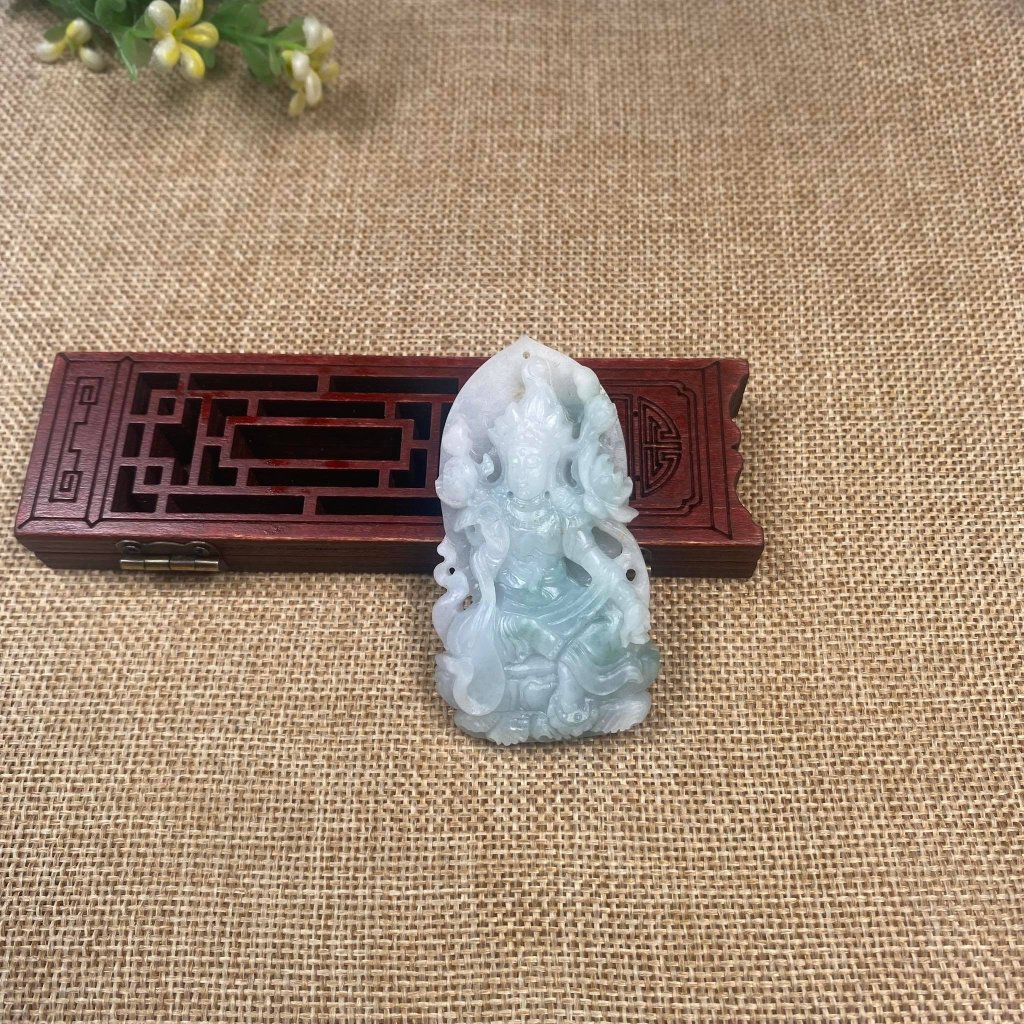
The Green Tara (Sanskrit: Shyamatara; Tibetan: Sgrol-ljang) was believed to be incarnated as the Nepali princess. She is considered by some to be the original Tara and is the female consort of Amoghasiddhi (see Dhyani-Buddha), one of the “self-born” buddhas. She is generally shown seated on a lotus throne with right leg hanging down, wearing the ornaments of a bodhisattva and holding the closed blue lotus (utpala).
The White and Green Taras, with their contrasting symbols of the full-blown and closed lotus, are said to symbolize between them the unending compassion of the deity who labours both day and night to relieve suffering. Under the influence of Tibetan Buddhism the different forms of Tara multiplied to a traditional 108. Tibetan temple banners frequently show 21 different Taras, coloured white, red, and yellow, grouped around a central Green Tara. The figure of the “self-born” Amitabha Buddha is often shown in her headdress, as she, like Avalokiteshvara, is considered to be an emanation of Amitabha.
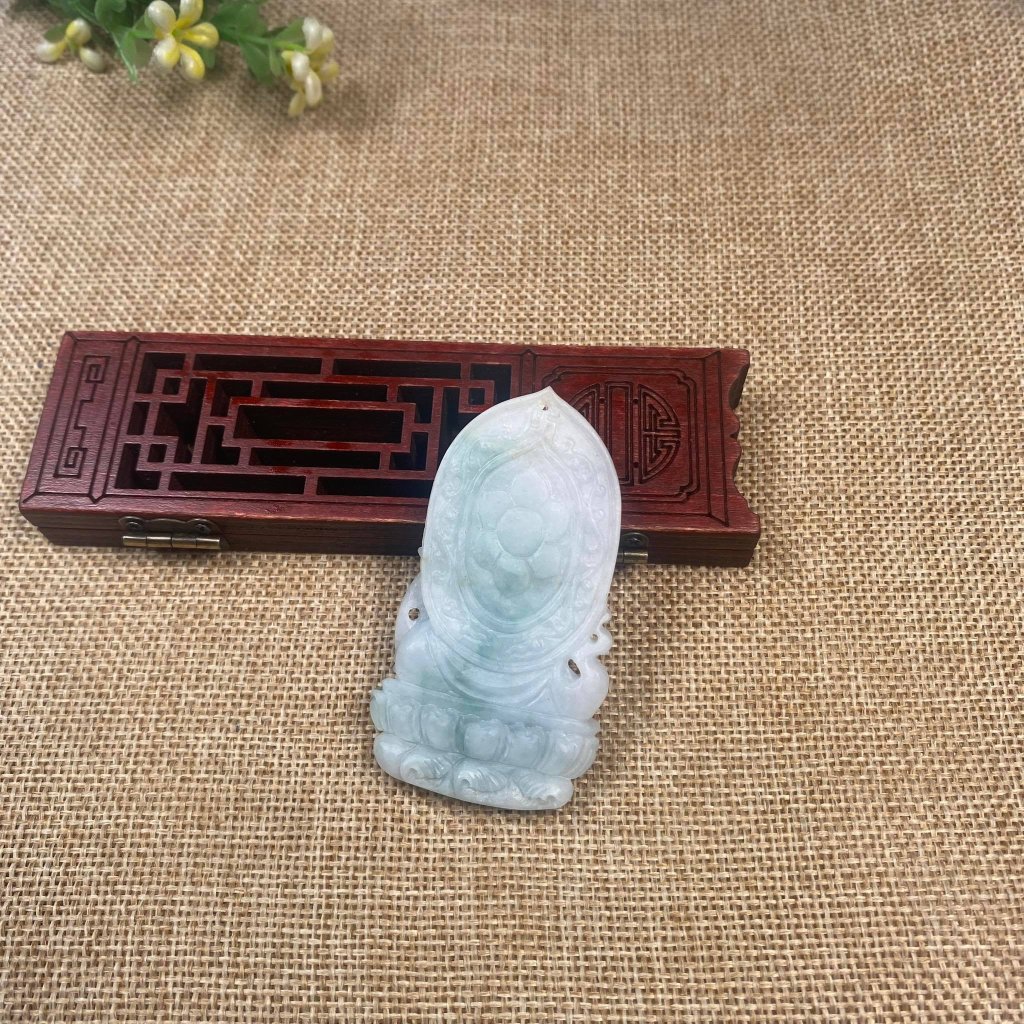
This beautiful Green Tara with blue blossoms is made of Burmese jadeite, look at how beautifully engraved and how serene the features are. It comes with a string chain and a certificate of authenticity. £208
 Faith’s Treasures